Motivation tip: manufacture momentum

You know what’s fun?  Eating lots and lots of Halloween candy.  You know what’s not so fun?  Trying to muster enough motivation to get out of your PJs and head to the gym the day after eating lots and lots of Halloween candy.

That was the problem I faced this morning.

Like so many other mornings in the last week and a half I had planned on exercising but quickly found some excuses as to why I couldn’t.  I’m too busy today.  I’ll go in the morning.  My brother’s in town so I should visit him.  It’s just not a big deal to skip another day.

And maybe it’s not that big of a deal, but you know what is?  Momentum.  People who don’t have momentum in their lives will find that every little thing that gets in their way has the ability to stop them, or at slow them down.  Those same little speed bumps might not even slow down someone who has big Mo on their side.

There’s a great little illustration about momentum in my favorite work of fiction, Jack London’s The Call of the Wild.  In one scene the main character, Buck, who also happens to be a sled dog, is the center of a betting pool.  His master, John Thornton, says Buck can “break out” a 1,000-pound dog sled and pull it for 100 yards all by himself.  (To “break out” a sled means to free it from the ice that has frozen it to the ground while it has been sitting still.)  Of the several hundred men in attendance to watch Buck attempt something deemed impossible, no one except Thornton believed the dog could accomplish something so great.

The sled Buck was to pull had previously been pulled by a team of 10 dogs, who were still hooked up to it as the men came out to watch the spectacle.  Those dogs were moved and Buck was fastened to the sled in his own harness.  Not only did he break the sled free of the ice that cemented it to the ground, but the longer he pulled the sled the easier and smoother it moved. Why?  Because of momentum.

Here’s how it went down:

“Now, MUSH!”

Thornton’s command cracked out like a pistol-shot. Buck threw himself forward, tightening the traces with a jarring lunge. His whole body was gathered compactly together in the tremendous effort, the muscles writhing and knotting like live things under the silky fur. His great chest was low to the ground, his head forward and down, while his feet were flying like mad, the claws scarring the hard-packed snow in parallel grooves. The sled swayed and trembled, half-started forward. One of his feet slipped, and one man groaned aloud. Then the sled lurched ahead in what appeared a rapid succession of jerks, though it never really came to a dead stop again…half an inch…an inch… two inches… The jerks perceptibly diminished; as the sled gained momentum, he caught them up, till it was moving steadily along.

So you see, if you feel like you’re trying to get things going but getting started is just too difficult, it may be that you just need to break loose your sled and get things going, trusting that momentum will kick in at some point.  If you want to be in shape next year, you need to suck it up and go to the gym today.  Break it out.  If you want to turn prayer and Bible reading into a helpful and enriching habit, you need to force yourself to get alone with God today.  Break it out.  If you just jerk a little, then take a break, then jerk a little, then take another break, you’re going to wear yourself out and maybe quit altogether.

I knew I needed momentum on my side, so I ultimately went to the gym and used the elliptical for half an hour, and you know what?  I’m going to do it again tomorrow.  Was it hard to convince myself that it was worth it?  Sure, at first.  But was it worth it?  Absolutely, because now that I’ve tasted the feeling of healthy again, it will grow progressively easier to get to the gym.  That’s Mo for ya.

Strength and Beauty Are Not Opposites

“Real strength never impairs beauty or harmony, but it often bestows it; and in everything imposingly beautiful, strength has much to do with magic.”

-Herman Melville

untitled-designThe above quote from Moby Dick refers to a whale’s tail, of all things, but there’s no doubt in my mind that the same could be said of God.  He’s almighty, the creator of heaven and earth, the one who holds the universe in his hands.  We describe him as omniscient (all-knowing), omnipresent (everywhere at once), and omnipotent (all-powerful).  He has no equal, and there’s nothing within reason for us to compare him to.  Our minds simply cannot comprehend his wisdom, presence, and might.

But at the same time, Jesus showed us God is no power-crazed war-monger.  In Christ, God stepped down from his throne in heaven, taking the form of a servant, in order to extend his grace to us.  He showed his gentleness by not roaring in like a lion ready to devour us because of our sin, but by laying down his life as a lamb so as to take the hit for us.  His gentle gesture was the most beautiful the world has ever seen.

I love the way the wise woman from Tekoa put it for David in 2 Samuel 14:14.  “All of us must die eventually,” she said.  “Our lives are like water spilled out on the ground, which cannot be gathered up again. But God does not just sweep life away; instead, he devises ways to bring us back when we have been separated from him.”

How much more gentle could he be?  Despite being able to easily “sweep life away,” he instead makes plans to gently reconcile us with him — now that’s beautiful.  Although we’re undeserving, he gives us a chance to be made right with him.

Like God, I aspire to be tough and tender too.  I enjoy training and competing in boxing and mixed martial arts.  I like movies like Gladiator and Ip Man.  I want to be strong and be able to protect my family from people who would try to harm them.

But I also want to be gentle in the way I speak and act toward my wife.  I want my son to know I’m not afraid to be affectionate, and that it’s okay for a man to show some emotion.  David was a vicious warrior who played the harp!  I think I’m in good company if I can both fight and enjoy a good sunrise.

So be strong and beautiful.  Be tough and tender.  They’re not the antithesis of each other.  In fact, as God has shown, there are few characteristics of a person that are more complementary!

Destiny, David, and Kung Fu Panda

Po_Kung_Fu_PandaWhen I think of the concept of destiny I think of Kung fu movies, and one of my favorite Kung fu movies is Kung Fu Panda (yes, I’m still a kid at heart). The movie’s main character, Po, is a fat and clumsy panda who dreams of being a Kung fu legend but is stuck working in a noodle restaurant with his father.  One day, through a series of funny and strange events, he is identified as the legendary Dragon Warrior by a Kung fu master named Oogway.

Once identified, the characters express three different beliefs about the situation:  Po seems to think he was chosen by accident.  The other Kung fu warriors seem to think he was chosen by mistake.  But Master Oogway, the wise, old tortoise of the bunch, believes that which looks like an accident or mistake is actually destiny intervening.

The rest of the story (spoiler alert) is a familiar one.  A great enemy — Tai Lung the snow leopard — escapes from prison and will surely destroy everything the other characters know and love, and Po the Dragon Warrior is expected to stop him.  But for the longest time it seems the panda will never amount to anything, and the situation seems so bleak that the other warriors try to stop the enemy before he can reach their town.  They’re defeated, of course, and Po becomes the town’s only hope.

Fortunately, he realizes just in time that the things he thought were holding him back (namely, his size and weight) are actually assets when used properly.  The things that make him different from the other fighters are actually to his advantage, and he eventually fulfills his destiny in dramatic fashion (don’t mess with the wuxi finger hold).

Destiny is a powerful idea because it is a guarantee on something that hasn’t yet been delivered.  In movies and literature a character who is fulfilling his destiny is one who is not only accomplishing the task he was created to accomplish, but he’s also becoming the person he was created to be.

But just as there was a period between when Po was announced as the Dragon Warrior and when he began to act like the Dragon Warrior, so there is often a period between when we learn of our destinies and we actually experience them.

For example, after King Saul disobeyed God a number of times, God finally rejected him as king of Israel and decided David should become king instead.  In fact, according to 1 Samuel 16, Saul was still on the throne when the prophet Samuel anointed David as king!  For a long time the newly anointed king of Israel lived like an exile, fleeing from place to place in order to avoid being killed by Saul.  But all the while he knew it was just a matter of time before he took the throne.

Here’s the principle: Often you’ll be anointed long before you’re appointed.  God calls things that are not as if they are, and in David’s case he called him king long before David actually took the reigns to the kingdom.

What is God saying about you?  What is he telling you to do?  What is he saying you should become?  If there seems like there’s a gap between you and where he wants you to be, maybe it’s because there is.  Just because he’s anointed you doesn’t mean he’s ready to appoint you just yet, probably because he wants to develop patience and trust within you.  The same is true of our salvation.  He calls us children long before we receive our promised heavenly inheritance, but we don’t have to worry about whether or not he’ll deliver on his promise, because it’s guaranteed thing.

God calls out our potential long before we ever see it achieved.  Has God called you to something?  Don’t be discouraged; be patient.  He will see you through in his own timing, and the wait will cause you to praise him even more when he delivers.

Obstacle, or opportunity?

GladiatorOne of my all-time favorite movies is Gladiator.  It’s about a Roman general named Maximus who is loved by his army as well as the emperor.  And Maximus has a dream — he wants to return the power of government to the Roman people.  But things go south when the emperor’s son, who is jealous of Maximus’ special relationship with his father, takes over the throne, kills Maximus’ family, and tries to kill the general himself.  Fortunately the assassination attempt fails, but Maximus is captured and sold into slavery.  Despite doing his best to serve his country faithfully, Maximus draws the short straw.

Many people would have given up at that point.  What’s the point of trying when the most powerful man in the world is against you?  But as a slave he becomes a gladiator and is such a skilled fighter that he quickly rises through the ranks until he has the opportunity to fight in the Coliseum in Rome.  

The emperor, once he recognizes Maximus, makes sure the general-turned-slave is faced with impossible odds, hoping one of the other warriors will kill him on the field of battle, but time and time again Maximus perseveres.  Finally the emperor, a skilled swordsman, decides to fight Maximus himself, but he rigs the match by stabbing Maximus before the fight even begins.

In the end (spoiler alert!), the two dual on the Coliseum floor and Maximus kills the emperor.  As a result, the wounded Maximus orders that power be returned to the Roman people — and sees his dream fulfilled — just before he dies.

Gladiator is a powerful story of perseverance in the face of everything that’s “not fair.”  It’s been said that 90 percent of our problems are self-inflicted, and we expect life to be difficult to some extent, but when we’re doing our best and our plans still seem to keep falling through, that’s when we really want to give up.  When the system is working against us.  When we feel our boss is incompetent.  When we get passed up for a promotion.  When we see other people getting special treatment.  When people are out to get us.  When we’ve been faithful to God but things still aren’t going our way.  These are the times when perseverance matters most.

Perseverance is like a fire extinguisher: It’s something we hope we never have to use, but we need to keep it around just in case.  We need to ready our hearts and minds to deal with the speed bumps that slow us from reaching our God-honoring dreams.  

For a long time I’ve felt the story of Maximus was just a knockoff of the story of Joseph.  Joseph was a guy who had everything going for him until his brothers’ jealousy caused them to do something terrible to him — sell him into slavery.  Over and over again Joseph got the short end of the stick, but despite the unfairness he experienced he persevered faithfully until God took him to a place of authority and used him in a way he could have never imagined.

Joseph couldn’t have anticipated the path he would take to becoming a ruler of Egypt.  He couldn’t have guessed his brothers would betray him.  He couldn’t have known he would become another man’s property.  He couldn’t have predicted he would be falsely accused of attempted rape and thrown into prison.  He couldn’t have foreseen that, even after miraculously interpreting the chief cupbearer’s dream, he would be forgotten for another two years before finally ascending to authority in Egypt.  No matter how unfair things seemed, Joseph always stayed faithful to God, and God showed his faithfulness to Joseph.

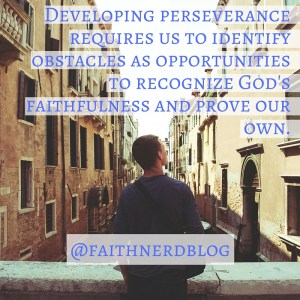
Developing perseverance requires us to identify obstacles as opportunities to recognize God's faithfulness and prove our own.Joseph seems to have understood something we need to learn for ourselves: developing perseverance requires us to identify obstacles as opportunities to recognize God’s faithfulness and prove our own.  We have to keep life in perspective and remember that going through hard times doesn’t mean God is done with us, it just means he’s building our character and testing our faithfulness.

Not all obstacles in life are dead ends.  Sometimes they’re just toll booths where God wants us to pay our dues so he can prepare us for what’s ahead!  Don’t lose heart, and don’t quit.  Stay faithful, and persevere!

Processing Tragedy and Learning to Empathize

Sometimes you have to take a step back from what's expected in order to better process what's in front of you.Sorry I’ve been away for so long! I was in Cleveland the last few weeks teaching English to a bunch of 4th-7th graders, but I’m ready to start posting again.

My teaching experience was fantastic.  I got to teach both The Call of the Wild by Jack London and Hatchet by Gary Paulsen, so expect posts about those two books soon, but before I go into those things I think I need to take a step back and offer some thoughts on the recent shootings and other heartbreaking events in the news.

I was in middle school, the 8th grade, when the 9/11 terrorist attacks occurred, and I’ve always really appreciated the fact that my history teacher at the time threw out his lesson plans for several weeks so we could focus on the significance of what had happened.  We needed time to process, time to ask questions, so he tossed out his plans and helped us cope, in a way, with the situation at hand.

I write all of this to say I realize this post deviates from the “finding faith in fiction” theme of this blog, but sometimes you have to take a step back from what’s expected in order to better process what’s in front of you:

Pithy is powerful

hway8According to legend, Ernest Hemingway was once eating a meal with some fellow writers when he bet all of them $10 that he could write an entire novel in six words.  Six words!  It seems ridiculous at first, which is why the other writers were probably pretty quick to take up his offer.  Hemingway then took his pen to a napkin and wrote these chilling words:
“For sale: baby shoes, never worn.”

He then passed the napkin around the table and, one at a time, each of the writers payed up.

This story about Hemingway, it turns out, is nothing more than a legend, but it proves an important point: pithy can be powerful.  You don’t have to be long-winded to make an impact with your speech or writing.  Preachers don’t have to spend hours and hours drawing out every little detail of a story, because the human imagination is powerful.  Allowing it to fill in the blanks actually adds more color to a story than a communicator could ever add on his own.

In the economy of words, less is more.

Jesus seems to have understood this.  Some of the sermons we consider the most powerful ever spoken are just a few sentences long.  Like Hemingway, Jesus got to the heart of the issue in a quick and memorable way.  His use of parables and short imagery allowed him to paint a broader picture without wasting his breath.

If you are a communicator by trade this kind of thing might really interest you, but what if you’re more of a behind-the-scenes kind of person?  Well, in Matthew 6, Jesus also told us the word count on our prayers doesn’t affect whether or not they’ll be answered:

“When you pray, don’t babble on and on as the Gentiles do. They think their prayers are answered merely by repeating their words again and again. Don’t be like them, for your Father knows exactly what you need even before you ask him!”

The Bible also encourages us to be better listeners than orators, and seems to suggest those that fail to listen well are more likely to be angry people too.  James writes, “Understand this, my dear brothers and sisters: You must all be quick to listen, slow to speak, and slow to get angry.”

Proverbs 17 suggests the same, saying, “A truly wise person uses few words; a person with understanding is even-tempered.”  It also goes on to say even fools seem intelligent when their mouths are shut!

So be wise and learn to do the same.  Listen well, allowing your thoughts be well-formed before they leave your mouth, your keyboard, or whatever.  And when you do speak, remember an entire novel can be written in six words!

When your calling isn’t clear

Ahab

Captain Ahab

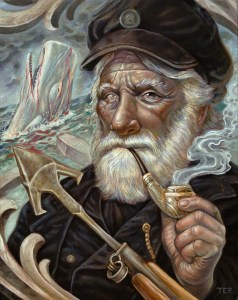
I was surprised while reading Moby Dick the other day because I felt envious of Captain Ahab.  Ahab the madman, who convinces his crew to forsake their mission for money in order to exact vengeance on the whale that took his leg, had me wallowing in the sin of jealousy — and he’s a fictional character.

The scene that got to me features Ahab alone in his chambers, taking a few moments to stew over his hatred for Moby Dick, when he begins thinking about his mission.  He gives himself a pep talk of sorts, thinking there is nothing that can stop him from killing the monstrous sperm whale, and then explains just how clear his mission is to him:

The path to my fixed purpose is laid with iron rails, whereon my soul is grooved to run.

I got jealous of Ahab when I read that line because, if I’m completely honest, I sometimes find myself fuzzy on what exactly I’m called to do.  I don’t like to share that often because it makes other people nervous, but when I’m going through particularly difficult times in work or in ministry I find myself thinking, Is this really what I’m supposed to be doing?  If I’m supposed to do this, then why am I struggling so much?

I believe “[God] has created us anew in Christ Jesus, so we can do the good things he planned for us long ago” (Ephesians 2:10).  There is great comfort for me in knowing not only that God has made me new, but he also has things for me to do!

But I often wish I were more like Ahab, a train on the clearly defined tracks of his own purpose, but in another sense I’m glad that’s not the case.  Knowing the inclinations of my own heart, I suspect I would become more about the mission than about trusting the mission-giver.  I would press on full steam ahead toward the goal but forget to lean on God in the process.

So for that reason I’m grateful God often reveals what we need to know when we need to know it, and nothing more.  He offers us directions one turn at a time, keeping us dependent on him and, in the process, showing us that when we walk in step with his Spirit he’ll never lead us astray.

Living in the Moment – A Lesson from Leo Tolstoy

Good stories are more than just entertainment; they have the power to be life-changing. Jesus understood this, and at times chose to let his illustrations be the sermon rather than just a part of it. In his parables he spoke of what were most likely some fictional characters and events, yet his works of fiction conveyed more truth than the combined contents of stacks of autobiographies.

From now on that will be the focus of Faith Nerd Blog: keeping an eye out for God’s truth in stories, especially works of literature. It’s a blog at the intersection of reality and make believe, reading everything through the lens of the Gospel.

Tolstoy’s Tale

Leo Tolstoy

Leo Tolstoy

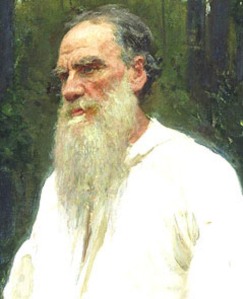
Leo Tolstoy wrote a great little story called “The Three Questions” in which a king theorizes he can avoid failure if he knows three things: the right time to begin everything, the right people to listen to, and the most important thing to do at any given moment.  

He surrounds himself with wise men who try to answer the three questions, but they have conflicting ideas so he decides to consult a hermit who is known far and wide for his wisdom.

The king disguises himself in order to talk to the hermit because the wise man will only receive “common folk.”  The hermit is digging in the ground in front of his hut when the king approaches to ask his questions, but when the hermit doesn’t answer, the king takes the spade and offers to dig a while so the hermit can rest.  

After hours of working the king becomes impatient.  He demands the hermit answer his questions, but just as he does so a man runs out of the woods bleeding from his abdomen.  The king washes and bandages the wound as best he can, but the blood keeps flowing.  So again and again he washes and bandages the wound, until finally the blood stops and the man’s life is saved.

By this time the sun has set and the wounded man is thirsty, so the king brings him some water and, with the help of the hermit, carries the man to the hermit’s bed to let him rest.  Afterward the king is so exhausted from his hard day’s work that he falls asleep.

When he awakes in the morning, the king finds the wounded man already awake.  The man apologizes to the king, not because he had been an inconvenience, but because he had actually come into the woods to avenge his brother’s death (and the loss of some property) by killing the king!  He had been wounded by the king’s bodyguard while on his mission, but is both grateful and astonished that his enemy would take such good care of him.  

The king not only forgives the wounded man, but says he will send his own servants and physician to care for him and will restore the lost property.

The king is happy to have made peace with his enemy, but still has some unanswered questions.  He asks the wise man one last time to answer his questions, and the man responds, “You have already been answered!”  The king, still confused, seeks more clarity, so the old man explains:

“Do you not see…If you had not pitied my weakness yesterday, and had not dug those beds for me, but had gone your way, that man would have attacked you, and you would have repented of not having stayed with me. So the most important time was when you were digging the beds; and I was the most important man; and to do me good was your most important business. Afterwards when that man ran to us, the most important time was when you were attending to him, for if you had not bound up his wounds he would have died without having made peace with you. So he was the most important man, and what you did for him was your most important business.

“Remember then: there is only one time that is important– Now! It is the most important time because it is the only time when we have any power. The most necessary man is he with whom you are, for no man knows whether he will ever have dealings with any one else: and the most important affair is, to do him good, because for that purpose alone was man sent into this life!

Learning from Leo

I love the message this short story delivers: one of the most important things you can do is live in the moment.  Even believers, who have the hope of eternal life in them, have to keep in mind that while heaven and perfection are our future we still live in the now, so we can’t neglect it or the people in front of us.

The most important time for you is right now.  One of my personal mantras is, “You only have today.”  It’s a constant reminder that you can plan ahead and reflect on the past, but you can’t possess any moment but the present.  So go out and carpe the crap out of your diem!  Don’t rest on the laurels of your faith by over-reflecting on what God did yesterday or get stuck waiting on what He’ll do in the future.  Today is the only opportunity you have to act.  Right now is the only time you have any power.  Use your now wisely!

What’s Your Next Step?

What's Your Next Step

My church offers something we call “Next Steps” to help guide our guests through the first few milestones of their faith. These steps include things like salvation, baptism, serving, giving, and getting involved in a small group.  What I love about our Next Steps is they provide a clear path for those who are new to the church but are unsure of how to answer the question, “What’s next?”

But regardless of how long you’ve been a believer, all of us should be trying to figure out our next steps. Proverbs 4:26 (NIV) says, “Give careful thought to the paths for your feet and be steadfast in all your ways.”  In other words, don’t just keep wandering through your life without considering where your feet are taking you!

As we mature in the faith it can sometimes require more prayer and patience to discern where we should plant our feet next, but that shouldn’t stop us from putting forth the effort. Quite the opposite, actually, because when we truly “walk by faith, not by sight” (2 Corinthians 5:7) God can take us places we previously thought it would be impossible for us to go!

Not only that, but I think failing to take your next step is to take your salvation for granted. Let me explain:

The first few verses of Acts 3 talk about a man who was born lame, unable to take a single step in more than 40 years of life. Each day he would beg for cash at the Temple, until one day Peter and John came along and Jesus healed the man through them.  The man’s response to the miracle was appropriate: “He jumped up, stood on his feet, and began to walk! Then, walking, leaping, and praising God, he went into the Temple with them” (Acts 3:8, NLT).

Not only is this an amazing and praiseworthy biblical event, but it’s also a powerful metaphor for our own spiritual condition.  From the time we’re born we are spiritually lame, and salvation is the first step our souls ever take after they are miraculously healed by Jesus.  But how ungrateful would we have to be to experience a miracle like that only to take one or two steps and then quit?

When you recognize it's a miracle you can even walk, every step is special.When you recognize it’s a miracle you can even walk, every step is special.  So as you consider your paths and prepare to take your next steps, don’t do so out of mere obligation, but walk, leap, and praise God for the miracle he’s performed in your life!

Need help figuring out your Next Step?  Click on the “Contact” tab to let me know and I’ll be happy to help!

Trust Fixes Troubled Hearts

image

When I put my son on my bed, he has a tendency to run fearlessly toward the edges, not realizing how dangerous it is to fall from that height.  He does this, in part, because he trusts me completely — every time he’s ever gotten to the edge I’ve caught him, so he has no reason to be afraid or worried.

In John 14, Jesus tells his disciples that the prescription for a troubled heart is trusting him. Those who trust him completely will have peace, and people who are at peace can also live confidently.